text and photo: Marko Pecotic, October 2013
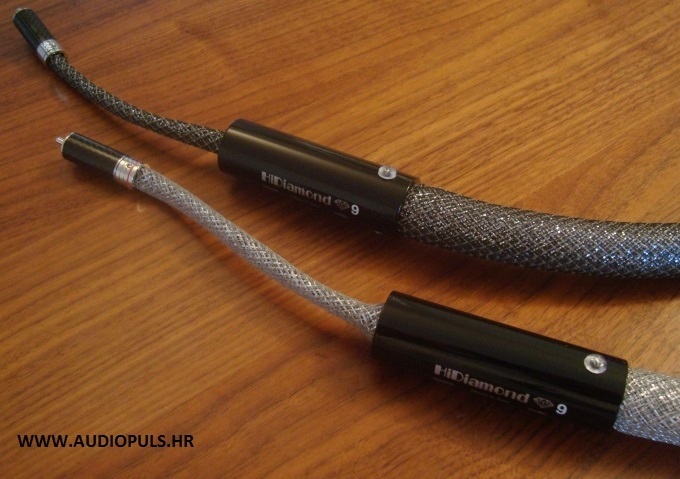
product: HiDiamond "Diamond 9" interconnect cable
manufacturer: HiDiamond S.R.L., Italy [www.hidiamond.eu]
price: 2x1m RCA = cca 2.170 EUR
Thousands and thousands of articles about cables are available on the web. Audio cables are perhaps the most discussed topic among audiophiles worldwide. Some claim that cables make absolutely no difference in sound, the others claim that good sound cannot be accomplished without buying expensive cables. The truth is, as always, probably somewhere in between.
Particulary discussed topic are power cords. Some will point out that it’s just impossible for power cables to have any influence on sound when dozens of ordinary and cheap cables are built inside the walls of every building – then how can 2 meters of an audiophile power cord make the difference in sound? I guess nobody knows the answer to that question. And it doesn’t matter. I wouldn’t bother myself with theories. The only important thing is – the sound. Do the power cords make the difference in sound or do they not?
Yes, audio cables – there’s no doubt about it – make the difference in sound. Are the cables an important part of the audio system? Yes. What about prices? Yes, in general, audio cables have too high prices. In other words, high price is no guarantee of sound quality.
Equalization is the wrong way
Why do we use audiophile cables, what's their purpose? I'm under impression that audiophiles often use cable to equilize the sound. In other words, cables are used to correct all the flaws in the sound (to reinforce the bass, to soothe the treble etc). Hmm... I find such concept to be completely incomprehensible. Such approach is completely wrong. Why should you spend tons of money on cables that are supposed to correct the sound of a Hi-Fi system? If your system in not balanced and has flaws, and you want to equlize it with cables, wouldn't it be easier (and cheaper!) to use the tone controls on you (pre)amplifier? I guess most audiophiles will respond negatively to this question...
Recently I spoke to an audiophile who has for the past two years been complaining about the lack of deep bass in his Hi-Fi system. So he borrowed two speaker cables for an audition (each cca 1.500 eur) hoping they'd add more bass he's been looking for. I told him it would perhaps be better to find the better placement for his speakers, or maybe to change the amplifier, not to do it with cables. He didn't like my words, that sounded like an insult to him... One of these two speaker cable had a big, pumped up mudy bass (in other words, pure loudness), and he liked it. I told him something like – there's really no need to spend 1.500 eur on this cable, you will get exactly the same result in sound if you turn the bass tone control to the right. Again, that sounded like an insult to him. In the end, he – of course – bought that cable... I belive that psychology (ie, ego) is also an important part of this story, it's the desire to possess expensive and branded cable.
Let's go back to the basics. How do you set-up a Hi-Fi system? Every system is a chain consisted of three basic links (source – amp - speakers). Connected with the most ordinary audio cables, the system should, if those three links are in mutual synergy and if they themselves are of a good quality, sound good (of course, in combination with good room acoustics and adequate speaker placement). If the system doesn't sound good (not enough bass, bright treble etc), a person should change one link in the chain or set-up the room acoustics or find the more adequate placement for speakers. A person should not spend the money on cables hoping that they will correct all the flaws in the sound and sudenly make the system sound good.
A few words about this cable...
Diamond 9 is the most expensive interconnect cable in the catalogue of this italian manufacturer. 1.700 eur is certnaily a lot of money for a piece of wire. However, if you take a look at other cable manufacturers and how much their top models cost - you might come to a conclusion that this cable is not that expensive.
Inside each Diamond 9 cable are four copper-graphite conductors made by the patented 4VRC technology, whereby the copper is being „cooked“ four times in order to obtain the lower values of inductance, capacitance and resistance. In the end of this procces, copper is being mixed with graphite creating an alloy. According to the manufacturer, graphite is there to block the passage of noise that passes through the electric (ie music) signal. Dielectric is XLPE (type of polyethylene), which, as the company says, has much better properties than Teflon. The cable is terminated with RCA rhodium connectors, and it needs minimum of 150 working hours to burn-in. The cable is about 20 mm thick in the middle and about 10 mm at the ends.
Sound
Generally, this cable is neutral and tonally completely „healthy“ along the entire frequency spectrum. Nothing stands out, nothing is missing.
This cable will, literally speaking, open the window. It lets go out all the signal, nothing is added, nothing is colorated. Instruments are physically palpable and full, never dry or thin. Drum snair has lots of air, the right proportions of the body and a bunch of details and sustain. Classical guitar is just right, with a clear distinction between each tone and each wire. Vocals are great: throat resonance are right, there's the air around the vocals etc. Stage is a large and lavish. Timing is excellent and exciting.
Bas is exactly as it should be: deep, fast, with appropriate volume. Someone might say this cable lacks more volume and "meat" in the bass region, but the bass is just as it should be: no loudness, no fake „meat“. If you want the bass to sound more attractive, look elsewhere.
Treble is clear, detailed and open (never bright), and it's not hyper - detailed. This does not mean that the treble on this cable is not detailed, this cable will just not squeeze out the very last detail, it's not super-extended.
To conclude, this is an excellent cable. Considering its price/sound ratio, my final score for this cable is 9/10.